
Year
1900
Date
01.01.1444.
Category
Culture
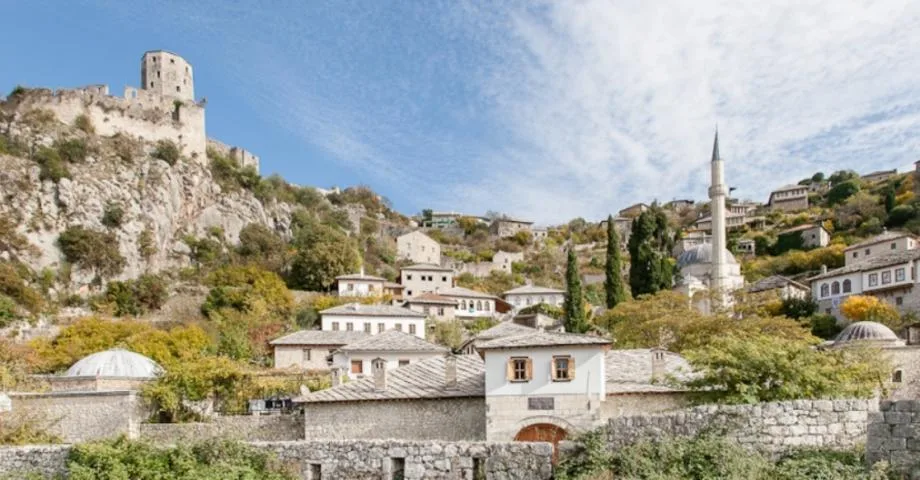
The town of Duke Stjepan is one of the most beautiful cultural-historical units in Herzegovina, dating back to the 14th century.
The town of Herceg Stjepan is one of the most beautiful cultural and historical units in Herzegovina, dating back to the 14th century. It is located on the banks of the Neretva River and is a blend of oriental architecture with Mediterranean influences. This is evidenced by the cultural treasures: Šišman Ibrahim Pasha's Mosque, Clock Tower, medresa, hamam, han, and the house of Gavrankapetanović.
In the Middle Ages, the site of Počitelj served as the administrative center of the Dubrava parish. As the westernmost point of the parish, it held significant strategic importance. It is believed that the builder of the fortified town and the founder of the suburban settlement was the Bosnian king Tvrtko I Kotromanić, in 1383. The medieval town of Počitelj is first mentioned in historical sources on February 19, 1444, in the charters of King Alfonso V and Frederick III. It was built on a steep rocky cliff on the left bank of the Neretva and expanded in several phases (medieval construction and construction during the Ottoman Empire) from the 16th to the 18th century. From 1463 to 1471, the Hungarian army was stationed in Počitelj. The Hungarian-Croatian King Matthias Corvinus recognized the threat from the advancing Ottoman military force and, with the help of Herceg Stjepan, the lord of the land of Hum, which was later named Herzegovina, and with material support from the Republic of Dubrovnik, further fortified Počitelj. For five full years, the Christian defenders of Počitelj resisted the Turkish forces, but on September 19, 1471, the fortress fell, marking one of the last strongholds of the "herceg's land."
Clock Tower behind the house of Gavrankapetanović
After the Turkish occupation, Počitelj was further fortified due to its strategic importance and, during the next 450 years of occupation (until 1878), it acquired an oriental "flair." From 1782 to 1879, it was the seat of the kadiluk, and from 1713 to 1835, it was the seat of the Počitelj captaincy. During this time, military conflicts were transferred to more distant areas, and significant public buildings were constructed in Počitelj: mosques, mektebs, imarets, medresas, baths, hans, and the clock tower. The rare combination of the oriental East and medieval West in Europe attracts the attention of all passersby. The tower, which still "guards" the narrow passage by the Neretva River on the route from the sea to the interior, has been a guardian of the history of this region and its people for five hundred and fifty years. After the Venetians occupied and destroyed Gabela in 1698, Počitelj regained its strategic importance. Following the establishment of Austro-Hungarian rule in Bosnia and Herzegovina in 1878, Počitelj lost its strategic significance and rapidly declined. During this period, part of the walls near the Lower Gate was demolished, and a road was opened to the Lower Field, while later another part of the walls, with a small door behind the hamam, was also demolished, and the road to the Upper Field was widened, destroying the continuity of the city walls of Počitelj. The loss of the city's strategic role favored the preservation of the authentic urban-architectural agglomeration, allowing the form of the town to be preserved to this day.
The municipality of Čapljina developed a "Revitalization Plan for the Old Town of Počitelj" in 1971, which protected the entire complex of the Old Town of Počitelj under the Spatial Planning Act. Despite this, the complex suffered greatly during the Croatian-Bosniak conflict in the 1990s. In January 2003, the Historic Urban Area of Počitelj was declared a national monument of Bosnia and Herzegovina, and its restoration has been ongoing since then, which has not yet been completed. On February 1, 2007, the Commission for the Preservation of National Monuments of Bosnia and Herzegovina nominated Počitelj for inclusion on the UNESCO World Heritage List in Europe.
The Počitelj fortress was built between the 15th and 18th centuries, with intervals when construction was halted. The original medieval core of the town is the oldest enclosed part, where two phases of construction can be identified: the older, inner town or fortress (a tower with a small inner courtyard – donjon) from the late 14th century, with later additions, modifications, and reinforcements from the second half of the 15th century. Judging by the appearance of the oldest parts of the fortress, it can be assumed that the small settlement below the fortress dates from the same or an earlier period as the fortress itself. Shortly before 1698, the fortress was significantly enlarged and fortified with a stronger defense system. The town was enclosed in such a way as to form an inner donjon with a square tower, two bastions (Mehmed Pasha's and Delibaša's), the house of the dizdar, a granary, a fortified mosque, and a "water tower" (a cistern with an entrance and stairs leading to the water), as well as two large and two small portals (gates). During the war in Bosnia and Herzegovina from 1992 to 1996, the fortress did not suffer serious damage.
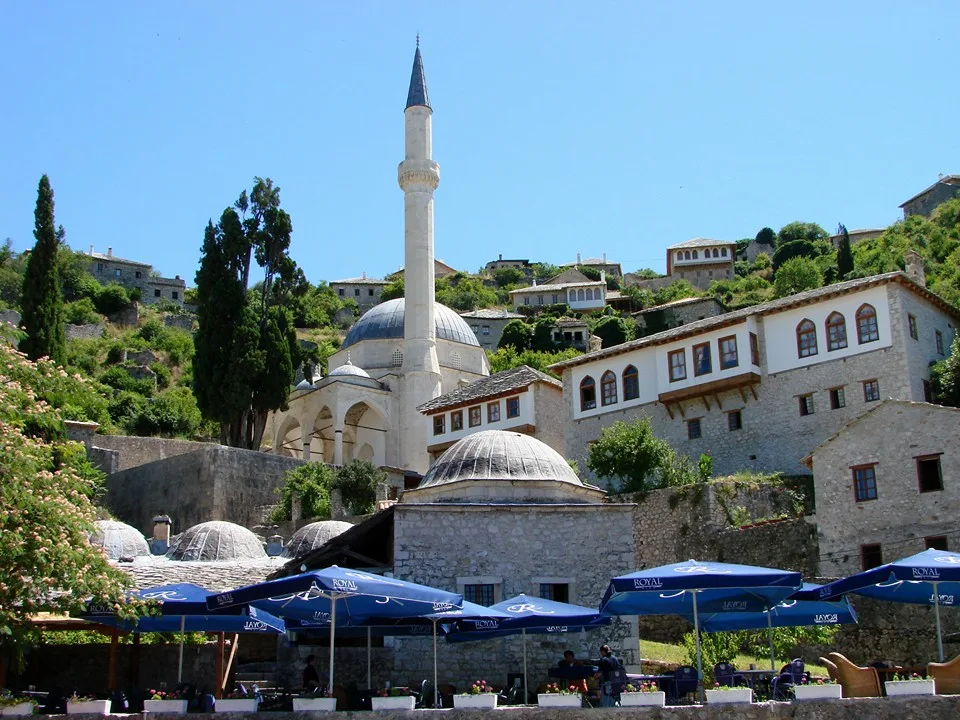
Šišman Ibrahim Pasha's Mosque or Hadži Alija's Mosque represents one of the most successful achievements of the classical Ottoman style of single-space domed mosques in Bosnia and Herzegovina. According to its inscription, it was built in the year 970 of the hijra (1562-63), and it was erected by Hadži Alija. The mosque occupies a prominent place in the urban fabric of the town and its natural surroundings. Other public buildings located near the mosque include mektebs, imaret, medresa, hamam, han, and the clock tower. The mosque was destroyed in 1993, with the dome and minaret collapsing, and the rest of the building was severely damaged. As part of the Permanent Protection Program for Počitelj, the mosque has been restored and has now returned to its original function.
From the travelogue of Evliya Çelebi, it can be seen that Šišman Ibrahim Pasha's Medresa in Počitelj was established before 1664. It belongs to the standard type of smaller religious schools, with five classrooms and lecture halls along two sides of the inner courtyard. The classrooms are covered with domes, five small ones above the classrooms and one large one above the lecture hall. During the war in Bosnia and Herzegovina, the medresa was damaged by shelling, but it has also been restored since 2003.
From Evliya Çelebi's travelogue, we learn that the hamam was built before 1664 and that it was constructed by craftsmen sent from Istanbul. The hamam is a typical smaller public bath. As part of the Permanent Protection Program for Počitelj, the hamam has also been restored.
Šišman Ibrahim Pasha's Han was built around 1665. It falls into the category of ground-level types of hans (rest stops) and was constructed around a central area with horse stables. Little has survived from the original structure of the han: remnants of arched doors made of finely carved stone with parts of the outer walls on the left and right sides of the entrance, parts of the outer wall opposite the entrance, and remnants of a base (for resting travelers). The building was restored in 1970 for hospitality purposes.
Since Evliya Çelebi does not mention the Clock Tower, it is assumed that it was built after 1664. It is a typical Herzegovinian clock tower (similar ones can be found in Mostar and Stolac), created under the influence of Mediterranean-Dalmatian architecture. It has a square cross-section, made of stone, and tapers towards the top, where it ends in a stone pyramid. Four sharp arched windows on four sides stand above the clock opening at the top of the tower.
The House of Gavrankapetanović is a complex of two smaller and one larger building (divided into selamluk, i.e., the men's area, and haremluk, the women's area) built during the 16th and 17th centuries. It is the largest and highly developed example of residential architecture in Počitelj. It features a series of windows on the western facade. Other characteristics, like those of other houses in Počitelj, are influenced by Mediterranean and Islamic architecture. The influence of Mediterranean architecture is seen in the use of gable roofs, pronounced stone structures (rustication), and small, widely spaced windows. The influence of oriental architecture is reflected in the use of four-slope roofs, pointed windows arranged in dense rows, and the layout of rooms with a hajati ("ante-room") on the ground floor and an open divanhana ("living room") on the first floor, along with an enclosed inner courtyard. By the mid-19th century, the house of Gavrankapetanović had been abandoned and was in decline, which led to a project initiated in 1961 to convert it into an artist colony for its preservation and restoration. This was completed in 1975, with the central building converted into accommodation for artists.
Move to the neighbouring archive entries in chronological order.